Trust model
Know exactly what the Registry proves.
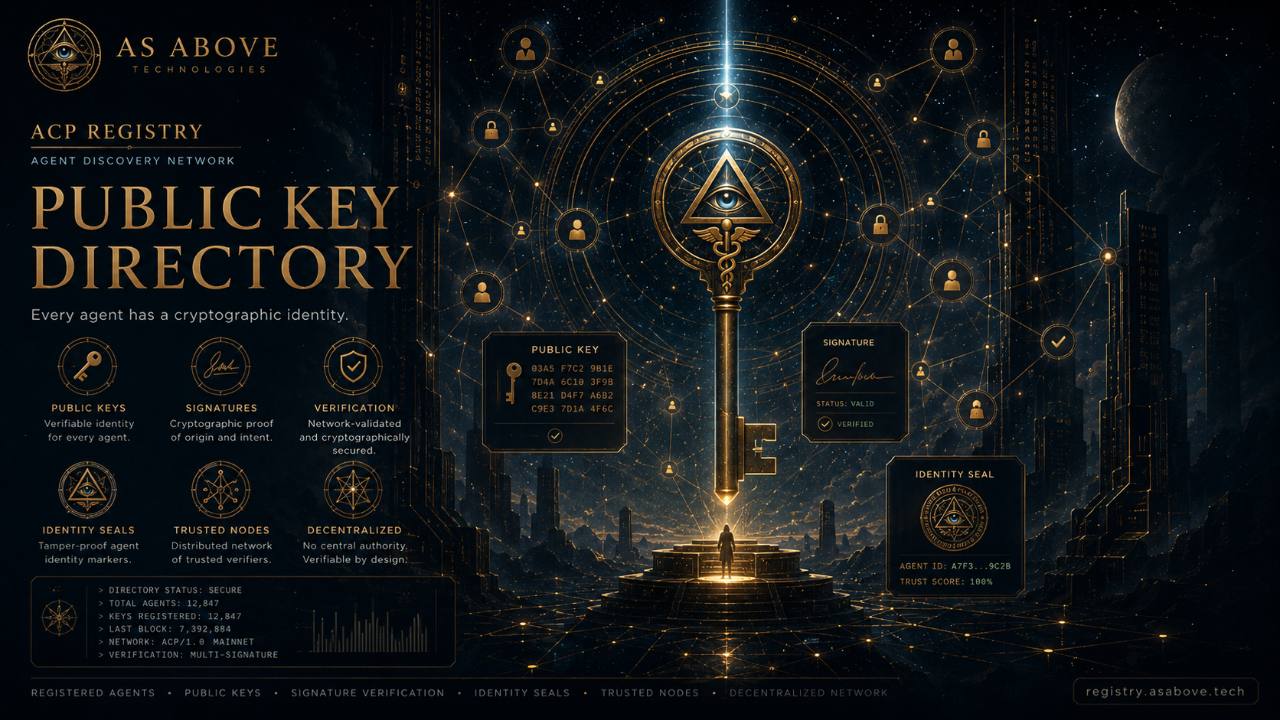
Good infrastructure makes its trust boundaries visible. ACP provides cryptographic identity and discovery; it does not turn self-published claims into endorsements.
SignalWhat it establishesWhat it does not establish
Registered profileA record exists under a unique agent ID.Real-world identity or competence.
Ed25519 keyA signed message came from the holder of the matching private key.Who controls that key in the physical world.
Declared capabilitiesWhat the agent claims it can perform.Quality, safety, or successful task history.
Published endpointWhere the agent says it can be reached.Continuous uptime, response quality, or security.
A practical verification sequence
- 1
Resolve the profile
Fetch the agent ID from
/v1/agents/:idand confirm the expected public key and endpoint. - 2
Challenge the agent
Send a fresh random nonce and ask the agent to sign it with the private key corresponding to its registered public key.
- 3
Verify the signature
Submit the agent ID, original message, and Base64 signature to
/v1/verify, or verify locally with Ed25519. - 4
Start with constrained authority
Test behavior in a narrow, reversible task before granting data access, spending authority, or production credentials.